
TL;DR
Challenge: Verizon Business Group needed strategic design leadership across fragmented teams serving customers, sales staff, and new markets—but lacked alignment and clear vision.
Solution: Built and led the CX Innovation Studio with a strategic operating model that elevated the team from tactical execution to strategic partnership. Developed AI Experience Heuristics to improve internal sales tools and created a "north star" vision to align cross-functional teams.
Impact:
-
Shifted relationship to strategic partnership with Chief Digital Officer
-
Broke down organizational silos affecting user experience
-
Brought clarity to AI-enabled enterprise tools lacking vision
-
$5M projected annual revenue increase attributed to Studio insights and research-driven business development
CX Studio Operating Model
The CX Innovation Studio was established to provide strategic insights to key stakeholders. Initially, we focused on developing a process for uncovering valuable CX insights, identifying and testing ideas within a given opportunity.
From there, we began collaborating with a broader team of stakeholders to align on priorities, making sure our findings made impact on work being delivered by multiple teams across the organization.
.png)
Accelerated Experimentation
One of the key challenges was a lack of testing and research velocity. We piloted a process using AI to develop live prototypes, which we could build and rapidly test. This allowed us to bring user validated, live concepts to stakeholders before the kickoff had even happend.
You can see an example of such prototypes here: velocityprototype.lovable.app

AI-Enabled Enterprise Tools
The Verizon B2B Sales team currently spends 40-50% of their time on non-selling tasks, working across 38 different tools including Artemis, B360, SFDC, Outreach, MyBiz, SNOW, and more. The goal of the Velocity suite is to automate and orchestrate these tasks in one "command center" netting 10-15 more hours per week on prospecting new business instead of servicing current customers.
When the Innovation Studio started, certain features and requirements had already been established, and we had to evaluate the tools and make recommendations for improvements. Our next step was to build concept prototypes to test with enterprise users, informing future product roadmaps. I designed and built the below prototype which is an email assistant that automatically generates responses to customer's questions with suggested templates that the user can insert in the draft of an email. This reduces the need to navigate multiple internal tools - pulling relevant information and enabling the sales team to focus on new business opportunities.


AI Heuristics for Enterprise Tools
Our first step was to audit the work that's already been done, however, our team lacked a comprehensive method for auditing AI experiences.
To address this, I developed a set of AI experience heuristics based off the Nielsen Norman usability heuristics. This established a baseline with which all AI products could be designed. It streamlined product design and decision making and improved the usability of enterprise tools.

Taxonomy & Interaction Patterns
To establish the high-level structure of this suite of tools, we looked at the jobs-to-be-done of our users. This informed an initial product suite taxonomy.
I compiled a list of relevant interaction patterns for each task. This helped us conduct a competitive analysis to understand the landscape of AI-enabled tools.
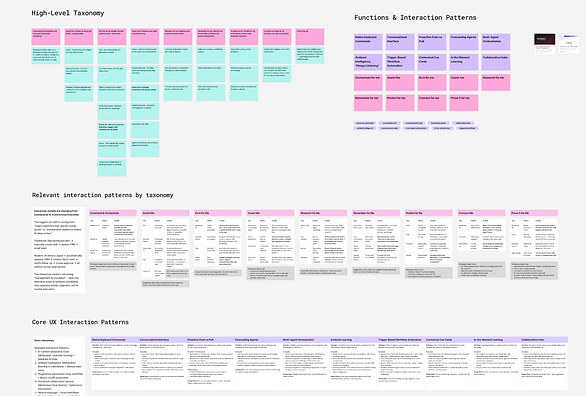.png)
JTBD Competitive Analysis
Based on the jobs-to-be-done established above, I looked at comparable AI-enabled experiences for inspiration and to understand the landscape of features.
I organized examples according to tools that provide Orchestration & Planning and enable enterprise users.

B2B Prospect and Customer Concepts
I developed live, end-to-end prototypes featuring streamlined, mobile-optimized purchase and verification flows. These prototypes incorporated AI recommendation engines that delivered personalized business plans, which we validated with users to inform product updates and align cross-functional teams. Visit fauxtel.lovable.app on your mobile device to see the live prototype.

Initial Insights and Analysis
Our initial analysis focused on emerging technologies such as Answer Engine Optimization or Agentic Search. We also looked at onboarding to increase engagement with the SMB app, BYOD user flows, personalized real-time offers and recommendations, and dynamic landing page.
These insights, which we presented bi-weekly to the SVP of Digital at Verizon Business Group, helped determine prioritization for the next year's roadmap.

Current State Audits & Recommendations
Our detailed analysis of existing experiences helped our Conversion Rate Optimization team A/B test improvements to the website and customer portal.
We used this analysis to identify and score opportunities, informing a prioritized 2026 roadmap with the objective to increase key conversion metrics by 5X.

Competitive Landscape Analysis
We also benchmarked Verizon's experience against other providers within the SMB ecosystem.
Our heuristic analysis of B2B sales experiences and enterprise products provided much need, insights-driven recommendations.

B2B User Research & Testing
Our research with small business owners uncovered insights about when and where these users prefer to interact with a human vs digital self-service. This informed a digital-first self-service plan option for flexible, capable business owners in exchange for a discounted monthly cost.

Prioritized Roadmaps
Once we identified opportunities through our research and analysis and once we validated our concepts via rapid, AI-prototyping, we scored the opportunities according to impact and estimated effort. This prioritization effort aligned previously siloed teams around key recommendations to achieve our ambitious 2026 objectives.
